Hepha’s Challenge
I’m not a bike journalist. I don’t have years of testing experience behind me, I don’t have a testing laboratory, and I don’t have the technical expertise to take a motor apart and analyse its individual components. What I do have is a pair of legs that pedal almost every day, first-hand knowledge of the terrain where I train, and a very specific goal: on November 8, I’ll be heading to Tunisia to take part in the Tembaine Desert Rally, one of North Africa’s most demanding mountain biking events. Six stages and more than 500 kilometres in the heart of the Tunisian Sahara.
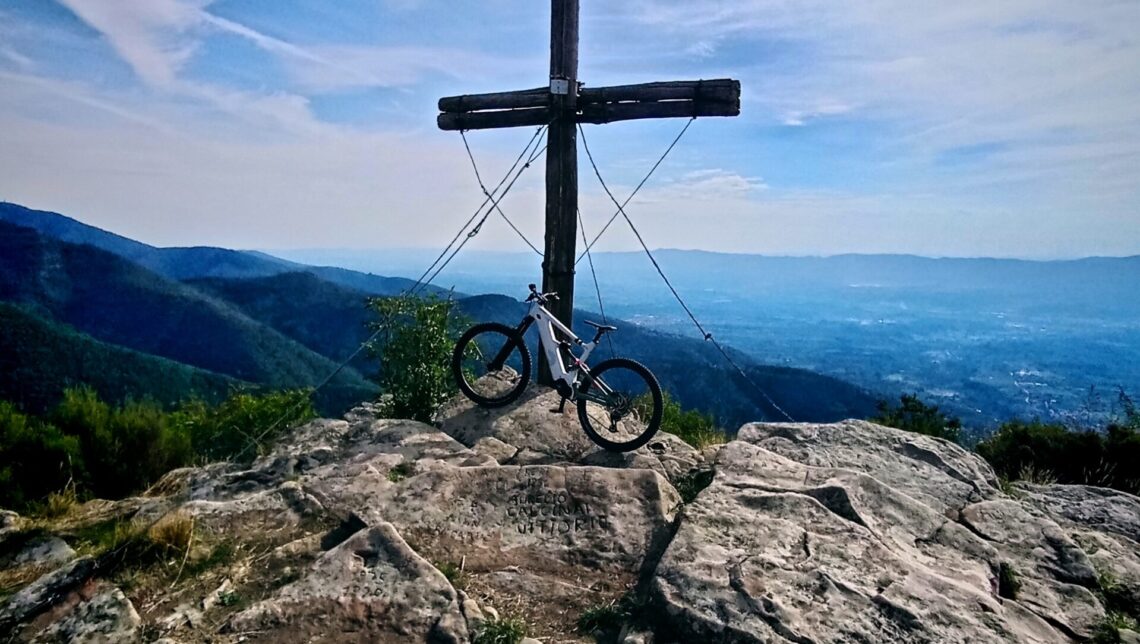
The bike I’ll be taking on this challenge is a Hepha All Mountain 7 Carbon Ultra. And this is its story, or at least the part I’ve experienced so far.
I’m not a professional cyclist either. I’m a film director and documentary filmmaker, and a few years ago I discovered mountain biking as a way to experience the world, not just observe it. I train almost every day in the hills of Valdarno, and I have a clear benchmark against which to compare my impressions: the Bosch Performance Line CX Gen5, the motor I’ve ridden for thousands of kilometres.
So what you’re about to read isn’t a laboratory review. It’s the perspective of an everyday rider who, for once, has to choose a bike for something far from ordinary.
Who is Hepha?
Hepha is a German brand founded in 2021. Young, ambitious and still relatively unknown in Italy, it is growing in the European market with a clear philosophy: to offer quality e-MTBs at a competitive price without necessarily chasing the very top end of the market.
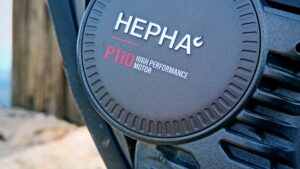
At the heart of its range is the proprietary HEPHA P110 motor, developed in collaboration with Gobao, a company with extensive experience in the e-mobility sector. The headline figure is 120 Nm of maximum torque. That’s an impressive number on paper, but it tells you very little about how a motor actually behaves when you’re out on the trail.
Reading 120 Nm on a specification sheet is one thing. Finding yourself on a steep climb, with the rear wheel searching for traction and the gradient getting steeper, is quite another. That’s when you discover how well a motor delivers its power and how much assistance it can give you when you need it most.
That’s where the real test begins.
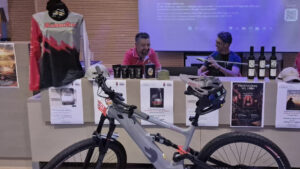
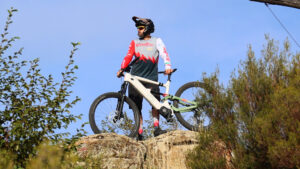
At the press conference with the Hepha All Mountain 7 Carbon Ultra I’ll be taking into the desert, alongside Roberto Fabbri, multiple Italian champion in enduro and cross-country and an official Tembaine Desert Rally ambassador.
Two bikes
Thanks to Beltain Schmid, Hepha’s Country Manager for Italy, and Mori eBike, Hepha’s official dealer in the Valdarno area, I had the opportunity to test not one, but two versions of the All Mountain 7 Carbon.
The bike I’ll be racing on at the Tembaine Desert Rally is the All Mountain 7 Carbon Ultra. It features a full-carbon monocoque frame, the P110 motor, an 800 Wh battery, a 12-speed SRAM GX Eagle drivetrain and 29-inch wheels.
It was shipped to Tunisia on October 15. With transport and customs clearance in the Sahara, there’s very little room for delays. Arriving at the start line with a bike I’d never ridden before would have been a rather creative way to approach a race like this.
In the meantime, Beltain lent me the All Mountain 7 Carbon Tschugg Signature for training. It has a slightly different specification, but the motor and battery are the same. There’s another interesting detail, too: this bike runs a beta version of the software, which made the test even more interesting, for better or worse.
The two bikes differ in their component specifications, but they share the features that matter most for my comparison: the motor, the battery and the carbon frame. Both also feature 29-inch wheels, 140 mm of rear travel and a 160 mm fork.
With that sorted, there was only one thing left to do: ride.
Testing the bike: Reggello, Pratomagno, Vallombrosa and Elba Island
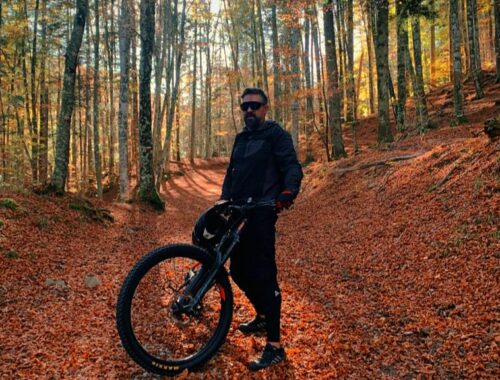
I tested the Tschugg Signature on my usual trails around Reggello, along the Pratomagno ridge and in the forests of Vallombrosa. These are places I know well, where I’ve clocked up plenty of kilometres, so they provide a useful benchmark for judging how a bike performs compared with what I’m already familiar with.
Then came Elba Island, where I took part in the Stefano Migliorini & Friends event. There, I had the chance to push the bike harder on more demanding trails, with technical sections and terrain quite different from the trails around Florence.
It was a varied test, and the results were interesting.
Handling: light, precise and treacherous
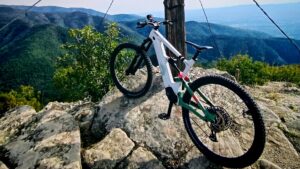
The first thing that struck me was the bike’s handling. You wouldn’t necessarily expect this from a full-suspension e-MTB weighing around 25 kg, yet on the trail it feels lighter and more responsive than the scales would suggest.
The geometry feels well balanced, cornering is predictable, and the bike inspires a level of confidence that, after a few rides, inevitably encourages you to push a little harder.
Perhaps a little too hard.
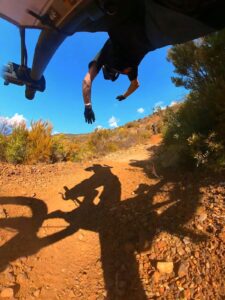
I took quite a tumble on Elba. Nothing serious — and I even have the photos to prove it — but with only a few weeks to go before leaving for the Sahara, it was something I could easily have done without. The funny thing is, I wouldn’t blame the bike. Quite the opposite: I suspect it happened because the bike handles so well that, at some point, I stopped giving it the respect it deserved.
It’s not a criticism. It’s a compliment, although my elbow might disagree.
The motor: comparing it with the Bosch Gen5
This is where things get interesting. I ride with a Bosch Performance Line CX Gen5 almost every day. It’s the motor I know best and, inevitably, the one I’ve come to use as my benchmark.
The difference is noticeable straight away, even in Eco mode. The Bosch Gen5 is very discreet in Eco: it assists you but almost disappears into the background. It feels as though you have a slightly stronger pair of legs, without constantly noticing the motor at work.
The Hepha P110 has a different character. Even in Eco mode, its assistance is more noticeable and more assertive. It gives you a tangible helping hand, even when you’re not asking for maximum assistance. It takes a few kilometres to get used to the difference, but once you’ve found your rhythm, the motor feels quite natural to ride with.
Boost mode is another story. With 120 Nm of torque, the assistance becomes particularly noticeable on the steepest climbs. You feel as though you have a substantial reserve of power ready to kick in just when your legs start to feel the strain. Of course, a climb is still a climb — unfortunately, the laws of physics don’t make exceptions — but the way you tackle it changes considerably.
For a race like Tembaine, this will be an interesting aspect to evaluate. It’s not just about having plenty of power; over a long event, you also need to understand how that power is delivered and how it affects battery consumption.

The software
One thing I like about the Hepha system is that you don’t need to be an engineer to use it. The assistance modes are intuitive, the motor’s response is predictable, and you don’t feel as though you need to learn how to programme a control unit before you can get on with riding.
For people who use an e-MTB to explore, tackle climbs and ride trails without spending ages adjusting settings, that’s a sensible approach.
The Tschugg Signature I used for testing also runs a beta version of the software. Since the software was still in beta, I paid particular attention to how the system behaved, especially when switching between the different assistance modes.
Range: the real surprise
If I had to single out one major strength, without hesitation I’d say the battery range.
I have a riding buddy who weighs about ten kilos less than I do. On every e-bike we’ve ridden together, after our usual rides of around 50 kilometres, he would almost always get back with about 10% more battery remaining. Weight, power demand, physics — nothing unusual there.
With the Hepha, however, something different happened. After our rides, I was the one with 10% more battery remaining.
I’ve observed this several times, and it genuinely surprised me because I wasn’t expecting it. The 800 Wh battery, combined with the way the system manages its energy consumption, seems to deliver very good range in my usual riding conditions.
And this is why that observation matters to me far more than a simple comparison between two batteries.
In the desert, range can become a very real concern. The stages are long, the sand puts both rider and bike under considerable strain, and there’s no stopping halfway through because you’ve miscalculated how much battery you’ll need.
If the extra range I’ve seen during training holds up in Tunisia, it could make a much bigger difference than any figure on a specification sheet.
Will it be my winning advantage at Tembaine? I don’t know. Let’s get started, and then we’ll see.
The verdict can wait
At this point, I could write that the Hepha All Mountain 7 Carbon Ultra is an extraordinary bike, that it has everything you need and that I’d recommend it without reservation.
But that would be too easy.
The truth is that a bike can impress me on the climbs around Pratomagno, make me enjoy the trails on Elba and surprise me with its range. The Sahara, however, is a different proposition altogether.
Out there, I won’t have my familiar trails or know what kind of terrain lies ahead. I won’t be able to turn back after 50 kilometres just because something doesn’t feel right. There will be six stages, more than 500 kilometres, sand, heat and fatigue — and a battery that will have to last as long as I need it to.
That’s why I can’t yet say whether the Hepha will prove to be the right bike for Tembaine.
What I can say is much simpler: so far, it’s convinced me.
We’ll find out the rest in the Sahara.
The real test, the one that truly matters, is about to begin.